


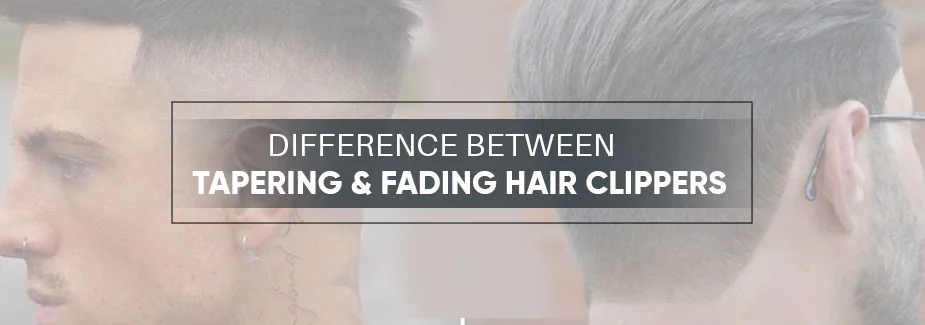
Modern grooming and barbering are primarily discussed with the terms “taper” and “fade,” both being often used interchangeably. However, these haircuts are not the same. Moreover, it is not only important to understand what is the difference between taper and fade haircut but how professional hair clippers are used to achieve each look.
As a barber, you require following one technique or both the haircutting techniques on your different clients as per their styling needs. This guide will break down the real difference between tapering hair with clippers and fading hair clippers for better performance and results.
What Is Tapering in Haircuts?

A taper cut can be defined as a subtle, clean and conservative haircut technique. You can differentiate this style by seeing a haircut that is gradually shortened from the top to bottom, typically around the sideburns and neckline, allowing you to maintain more length overall for a clean and professional appearance overall.
The barbering technique of taper haircut for men results in somewhat like a smooth transition from less to more, often giving the look of longer at the top section of hair and getting shorter towards the side and neckline to deliver a blending look. Here's a breakdown of tapering for a better understanding of the haircut:
-
Technique: Tapering involves adjusting the blade lever or using several clipper guard sizes to be able to create a smooth transition in the length of your clients’ hair and deliver a natural look.
-
Clipper: The Vega Professional Pro Star+ Hair Clipper with Japanese Stainless-steel blades can be your perfect pick for the best results. The ideal combo of power and precision, this professional hair clipper is powered with a 7,000 RPM high-speed rotary motor that delivers high torque and constant speed. You can choose from its 6 premium attachment guide combs basis your client’s hair length and experience easy manoeuvrability with its ergonomic design.
-
Length Variability: While the hair at the top is left longer, the length starts to gradually reduce as it moves towards the neckline and around the ears.
-
Best For: Business or formal styles, Natural & low-maintenance look, classic cuts like side parts or comb-overs and strong contrast or sharp blending.
What Is Fading in Haircuts?

The fade haircut for men is a more dramatic transition where hair blends from very short (often skin level) into longer lengths. Unlike tapering, fading hair with clippers is considered to be a more distinct and complicated haircutting technique. This particular cut involves blending hair from extremely short, including skin-level, to a longer length, in a shorter space. It requires the need to seamlessly blend short hair into long hair to deliver somewhat like a gradient effect without distinct lines or steps in length. Keep reading to know more about this haircut:
-
Technique: Due to its intricacy, faded clippers should be able to deliver precise results. You must use many guard sizes or adjust the clipper blade lever to be able to make a transition from short to long hair in a smooth manner. This technique typically has a more noticeable contrast between the different lengths of hair and is often used on the sides and back of the head where the hair gets shorter gradually towards the neckline.
-
Professional Clipper: One of the best hair clippers for fading to try from Vega Professional is the Vega Professional Pro Buzzer Cord/Cordless Hair Clipper featuring DLC Coated Japanese Stainless-Steel Blades. It offers both Cord and Cordless power for versatility and a 6000-rpm high-speed rotary motor for a powerful performance. Moreover, its 6 attachment guide combs come in multiple colors to easily identify the size as required when catering to clients.
-
Types of Fades: There are several types of fades that you can create for your clients including low, mid, and high fades.
-
Best For: Trendy & modern hairstyles, sharp & edgy looks and styles like fades with curls, pompadours or textured tops.
Key Differences Between Tapering and Fading Clippers
Although the same clipper machine can be used for both, the technique and setup differ.
|
Feature |
Tapering |
Fading |
|---|---|---|
|
Hair Length Transition |
Subtle and gradual |
Dramatic and tight |
|
Clipper Guards Used |
Mostly higher guards (#2–#4) |
Wide range (#0–#2, including half sizes) |
|
Skin Exposure |
Minimal or none |
Often includes skin fades |
|
Blending Style |
Light blending |
Precision blending |
|
Clipper Technique |
Simple strokes, fewer adjustments |
Advanced technique, lever play, flicking motion |
|
Overall Look |
Natural and conservative |
Sharp and modern |
Clipper Techniques: Taper vs Fade

The Vega Professional Vector 2.0 Hair Clipper is another best clipper for both fading and tapering work. It boasts the high-grade DLC Stainless-Steel Faper Blades that comprise of both taper and fader blade designs. Additionally, its ultra high-speed patented vector motor with Smart Automatic Torque Control Technology ensures smooth operation. Here’s how you can use a professional clipper for tapering and fading cuts:
Tapering Technique:
-
Use longer guards
-
Follow natural hairline
-
Light “flick-out” motion at edges
-
Minimal sectioning
Fading Technique:
-
Start from shortest length (often zero)
-
Build upward in sections
-
Use lever control to soften lines
-
Constant blending between guard levels
Key Takeaway
Tapering and fading are both essential barbering techniques, but they serve different purposes. Hence, by understanding what is tapering in hair cutting and fading haircutting technique, you can achieve the perfect results. While a taper is all about subtlety and natural flow, fade is about precision, contrast and bold style.
FAQs
What is a taper haircut?
A taper haircut gradually shortens the hair length around the sides and back.
What is a fade haircut?
A fade haircut blends hair from very short into longer lengths.
What is the difference between a taper and a fade?
A taper is subtle and limited to edges while a fade is more dramatic.
Is a taper haircut more professional than a fade?
Yes, a taper is generally considered more professional due to its clean, conservative, and less dramatic appearance.
Which haircut requires more maintenance, taper or fade?
A fade requires more maintenance because its sharp, short gradients grow out quickly and need frequent touch-ups.
